

Your gut health affects your overall well-being — from digestion to immunity and even mood. By incorporating these 10 specific Indian foods for gut health into your daily meals, you can naturally nourish your gut bacteria and enjoy long-term digestive health benefits.

In my yoga classes here in Jabalpur, students often come to me with a common complaint: “Sir, I am practicing my asanas every day, but I still feel heavy and lethargic.” They think the problem is their muscles or their flexibility. But 9 times out of 10, I tell them the problem isn’t in their limbs—it’s in their Agni (digestive fire).
At My Yoga Ayurveda, I have always believed that you cannot out-exercise a bad diet. You have a “second brain” hidden in your gut. If your gut is unhappy, your mind will be unhappy—no matter how much meditation you do.
We often look for expensive supplements or foreign superfoods to fix our digestion. But the truth is, our traditional Indian kitchen holds the best secrets. Today, I want to share the 10 specific foods I personally recommend to my students to restore their gut health naturally.
Gut health means how well your digestive system works and how balanced the bacteria and other microbes are in your intestines. This community of microbes is called the gut microbiome. A healthy gut microbiome helps break down food, absorb nutrients, keep your immune system strong, and can even affect your mood.
When your gut bacteria are out of balance, you might feel bloated, constipated, or face other digestive problems. Poor gut health has also been linked to more serious issues like inflammation, obesity, and some chronic diseases.
In our ancient texts, gut health is simple. It is all about Agni (Digestive Fire).
Ama is the root cause of that bloating, gas, and heaviness you feel. The foods I have listed below are chosen not just because modern science says so, but because they kindle Agni and help flush out Ama.
Understanding the difference between prebiotic and probiotic foods is important to improve gut health:
Eating both types of foods together creates a healthy environment in your gut and improves digestion, immunity, and overall health.
Here is my curated list of essential foods available in every Indian market that will transform your digestion.
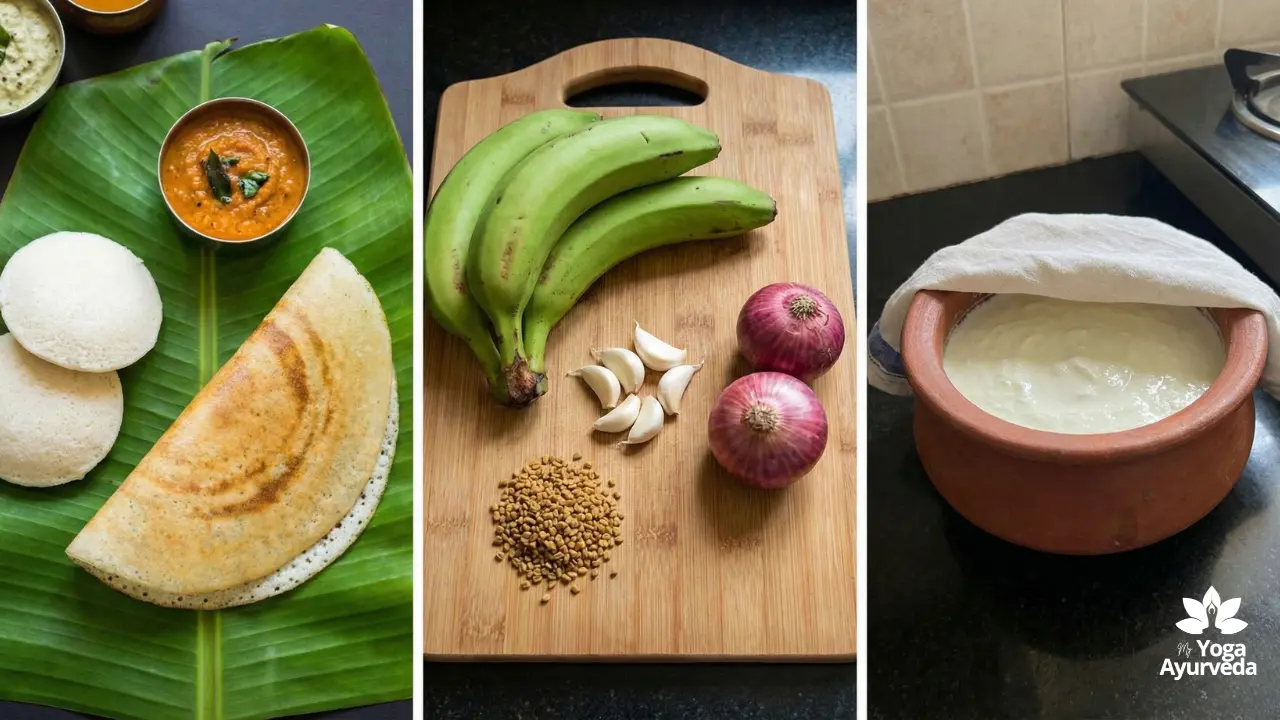
In many Indian households, we ignore the green banana until it turns yellow. But as a prebiotic, the green one is gold! It is rich in Resistant Starch, which resists digestion in the stomach and feeds bacteria in the intestines.
Garlic is naturally high in Inulin, a fiber that fuels gut bacteria. In Ayurveda, we consider garlic Rajasic and heating. It destroys toxins.
Like garlic, onions are a powerhouse of fiber. They help break down fats and boost the immune system.
These small yellow seeds contain mucilage (a gel-like substance). When soaked, this mucilage coats the stomach lining, protecting it from irritation.
I often see people eating only refined wheat or Maida. Maida acts like glue for the gut—it sticks and clogs. Millets like Jowar and Bajra provide roughage that keeps bowels regular.
Below are the best natural probiotic foods in India that you can make at home.
This is the most common source of Lactobacillus in India. It cools the stomach and neutralizes excess Pitta (heat).
While curd can be heavy for some, buttermilk is light. In Ayurveda, Takra (buttermilk) is considered the “nectar of the gods” for digestion.
The fermentation of rice and urad dal creates a powerful probiotic environment. This process also breaks down anti-nutrients, making the minerals easier to absorb.
If you are in North or Central India during winter, you must make Kanji. It is made by fermenting black carrots, water, mustard seeds, and salt for 3-4 days in the sun.
I am not talking about the oily, vinegar-filled pickles you buy in plastic jars at the supermarket. I mean traditional Ghar ka Achar made with salt, spices, and sunlight.
For a quick reference, save this table or take a screenshot to use when you go grocery shopping.
| Type | Food | How It Supports Gut Health |
|---|---|---|
| Prebiotic | Raw Banana | Contains resistant starch that feeds good gut bacteria. |
| Prebiotic | Garlic | Rich in natural fibers that feed healthy gut bacteria. |
| Prebiotic | Onions | Rich in inulin fiber that nourishes gut bacteria. |
| Prebiotic | Methi Seeds | Has mucilaginous fiber that soothes the gut lining. |
| Prebiotic | Whole Grains | Provide fiber that feeds good bacteria. |
| Probiotic | Curd (Dahi) | Contains live Lactobacillus bacteria that improve digestion. |
| Probiotic | Buttermilk | Hydrating fermented drink with probiotics. |
| Probiotic | Idli/Dosa | Rich in lactic acid bacteria and B12. |
| Probiotic | Kanji | A traditional fermented drink that boosts gut microbial diversity. |
| Probiotic | Pickles | Contains natural probiotics and enzymes. |
Since “how to make it” is just as important as “what to eat,” here are two simple recipes I use at home.
As a yoga teacher, I cannot end this blog without telling you how to move your body. Food is fuel, but movement is the spark.

This is the only asana you can (and should) do immediately after eating. It blocks blood flow to the legs and directs it to the stomach, speeding up digestion.

Do this in the morning on an empty stomach. Lie on your back, hug your knees to your chest, and lift your head. As the name suggests, it releases trapped gas.
Even if you eat the best foods, avoid these “gut killers” that I often warn my students about:
Q1: Can I eat curd (dahi) at night for gut health?
A: According to Ayurveda, it is best to avoid curd at night. Curd is heavy and increases mucus (Kapha) in the body, which can disturb sleep and digestion. The best time to eat curd is during lunch when the sun is high, and your digestion is strongest.
Q2: I feel bloated when I eat more fiber. What should I do?
A: This is common when you suddenly increase prebiotics like garlic, onions, or millets. Your gut bacteria are adjusting. Start with small quantities (e.g., half a bowl of millet instead of a full bowl) and drink plenty of water to help the fiber move through your system.
Q3: Are store-bought pickles healthy?
A: Generally, no. Most supermarket pickles are preserved with vinegar and preservatives that kill healthy bacteria. For probiotic benefits, stick to homemade pickles (Ghar ka Achar) made with oil, salt, and spices, fermented naturally in sunlight.
Q4: Should I take probiotic supplements?
A: As a yoga teacher, I always recommend natural food first. Supplements can be expensive and often contain only one or two strains of bacteria. Natural probiotic foods in India like Idli, Kanji, and Dahi contain diverse colonies of bacteria that are better suited for our bodies.
Q5: How long does it take to improve gut health?
A: If you follow these tips and practice Vajrasana daily, you may feel relief from bloating within 3 to 5 days. However, rebuilding a completely healthy gut microbiome typically takes about 2 to 4 weeks of consistent healthy eating.